Activities & Days Out / 18 July, 2024 / My Baba
Hooray, it’s holiday time! Travelling and flying with a baby is a whole new experience, and it can be daunting, but we caught up with Ergobaby who has plenty of experience making travelling with a baby as easy as possible.
With the right preparation, you can limit the ‘turbulence ‘of your first flight with your baby. Here are some of the questions they’ve been asked most, and their top tips for flying with a baby.
It’s probably sooner than you think. The NHS advice is that it is safe to travel once the baby is over two weeks old but depending on where you live and where you are flying to there are no standard regulations, so it’s best to check with your airline before you book. Some airlines may ask you to provide a fit-to-fly letter from your doctor if your baby is less than two weeks old.
If you gave birth by caesarean section, you may need to wait until after your six-week postnatal check-up before you take to the skies. Even then, you should only fly when your midwife or GP gives you the all-clear.
It’s usually easier to wait a few weeks before flying, to give you time to settle into life together. Also, your baby is more vulnerable to germs during their first month so you may not want to coop them up with dozens of strangers on an aeroplane. Waiting until after your child’s first vaccinations can also help you board the plane with greater peace of mind.
In addition to age, the stage of development and health of your baby are also important factors that determine whether your little one is ready to fly so check in with your paediatrician or GP if you have any specific concerns. This can also be useful for older children if they have a respiratory infection, suffer from earache etc.
If your child is under two years old, you aren’t legally required to purchase a seat for them. Instead, you have the option of holding your baby or toddler in your lap or in a baby carrier. You can purchase a seat for them under this age but you will need a flight-approved car seat or appropriate restraint system for them to sit in. Check your airline’s policy on this as they vary. On longer flights, when making your booking it is often possible to reserve a seat with a bassinet in front for young babies. The extra floor space in front can also be useful for containing a baby on the move. Speak to your airline as early as possible to reserve this.
From birth, your baby will need a passport for any trip where you leave the UK. A child’s passport is valid for five years, which is worth bearing in mind if they have any older siblings that might need a renewal soon too.
And don’t forget to keep your baby carrier to hand, you’ll be glad to have your hands free to carry bags and navigate the airport while keeping your baby close.
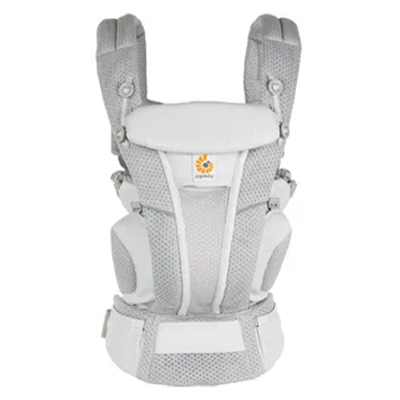
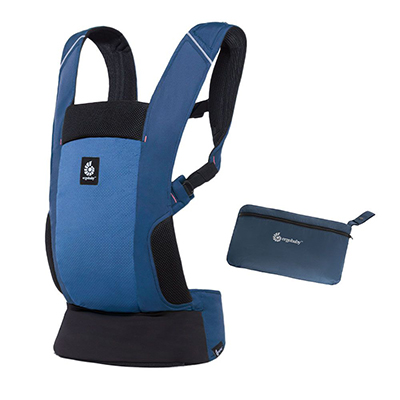
The Ergobaby Omni Breeze is a favourite for travelling, it’s easy and comfortable to use, and will last you from newborn through toddlerhood with all four carry positions. Its breathable mesh fabric keeps you cool in warmer climates and it packs away easily when you’re not using it. If compactness and convenience are your priority, then a lightweight, portable carrier that can fit in your handbag, like the Ergobaby Away, is a great choice.
Most airlines allow you to check in up to two items such as a collapsible stroller, car seat or travel cot free of charge in addition to your basic allowance. You can often keep your stroller with you through the airport and then leave it at the plane steps when you board, then pick it up from oversized baggage after your flight.
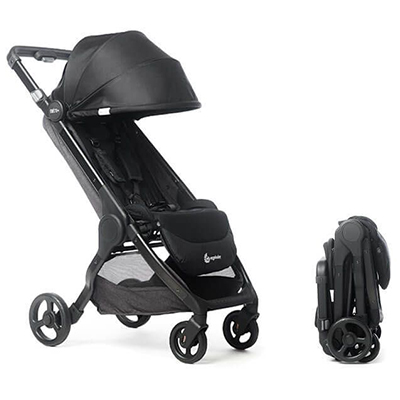
Or, if your stroller is ‘cabin friendly’ (like the Ergobaby Metro+ or Metro+ Deluxe), then you can take it on board with you as a piece of hand luggage, meaning you’ll always have it with you, particularly handy if you might have to queue for passport control or have a wait for your bags.
Some airport chemists also allow you to do click-and-collect orders and many airlines allow a bag of duty-free shopping alongside your usual allowance. So, if there is anything you need that won’t fit in your luggage you could try this travel hack.
There are various options here. For small babies in particular, the easiest way can be to carry your little one in their baby carrier. It’s a great option to help you keep your baby close and settle them if they are uncomfortable or overwhelmed. Travelling can be tiring so a baby carrier also gives the baby a safe place to sleep away from the hustle and bustle of an airport. It also gives you two hands-free to manage luggage, browse duty-free or look after other children. You can even breast-/chestfeed babies in your carrier if that’s how you feed them. The integrated hood found on many Ergobaby carriers can offer extra protection and privacy.
A compact stroller like the Ergobaby Metro+ range is also a great choice, it is cabin-friendly so can stay with you throughout your journey and its near-flat recline is the perfect safe space for babies to take a nap when they need it. Alternatively, you can pop it in a carry bag (available to purchase separately) and carry it on your back through the airport if you’ll be using your carrier instead.
If you’re taking your baby’s car seat on the plane, the Metro+ also has car seat adapters available separately so it can be used to transport the baby through the airport in their car seat too to save you having to carry it.
To avoid queuing for a long time with little ones, some UK airports have special assistance and family lanes in security for departing families. When you’re travelling with young children, these dedicated lanes will give your family extra time and help to get through security. Keep an eye out for signs and ask the staff at check-in if there is any special provision for families.
Some airports will even let you keep your baby in your baby carrier as you walk through the scanners, perfect if they’re sleeping or feeling overstimulated by everything around them, but this is at the airport’s discretion.
If you’re using a stroller through security, it likely won’t go through the scanners so a member of the staff will take it past the scanners to be checked separately. All items will need to come out of it for these checks.
When flying with a baby you are allowed to take enough baby food, baby milk and sterilised water for the journey with you in your hand luggage. There is no legal limit to how much you can take however we always recommend checking with your airport before you travel as some have their own restrictions. These containers usually need to be screened separately so speak to staff when you get to security. Sometimes airport staff might need to open the containers to screen the liquids. You can usually also carry (unfrozen) breast/chest milk in hand luggage even if you’re not travelling with your baby.
Take-off and landing are not always pleasant, even for us grown-ups. But unlike us, babies can’t equalise the pressure in their ears themselves yet. The best way to help your little one is by feeding them their usual milk during take-off and landing. A pacifier or dummy can help too if your little one uses one. For older children, chewing and swallowing a snack can help equalise the pressure.
Changing nappies on a plane is never going to be easy. Between tiny (or non-existent) changing tables and the potential for nappy explosions during the worst turbulence, the challenges are real. But it’s totally possible to hack even the most challenging of aeroplane nappy-changing situations.
To minimise the number of changes you need to make on any given flight, make sure to schedule a nappy change as close to boarding as possible in the airport before you board your flight. Airport lavatories have much larger changing stations and more room for you to operate. Some airports even have dedicated family facilities. Aeroplane lavatories can be small and there is simply no room for you, your baby, and a large change bag. We recommend bringing a small removable change bag with you, including a few nappies, travel-size wipes, plus some nappy cream and bags if you need them.
Hopefully, you’re now feeling fully confident about flying with a baby and this knowledge means you can start your holiday well equipped and relaxed. And whether it’s a baby carrier helping keep your hands free through the airport, or a compact stroller offering baby the perfect nap spot while you queue for passport control, Ergobaby is by your side to make flying with baby significantly easier.

Turn everyday adventures into exciting language-learning moments with the Dex Camera. Designed for children aged 3 to 8, this innovative camera recognises everyday objects and transforms them into fun, interactive language lessons. Supporting 16 languages and 30+ dialects, Dex encourages curiosity, confidence and real-world exploration through play. Plus, My Baba readers can enjoy an exclusive 10% off with the code 10BABA at checkout.
My Baba Measure / 14 October, 2026
Christmas Gifting / 14 October, 2026